 Hi, I’m Ryan
Spectrum Digital Purchase Experience
Reimagining the purchase journey while evolving how teams build together
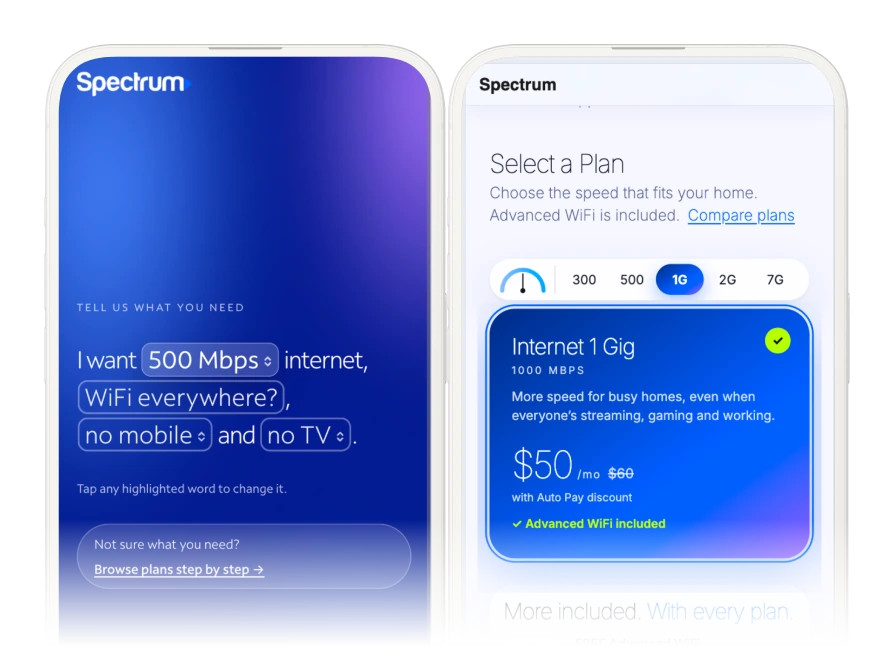
Conceptual Work Only
Problem
Choosing home services means navigating products, speeds, equipment, and pricing, often before customers understand what best fits their needs. I saw an opportunity to create a more engaging purchase journey that helps customers learn, understand their options, and feel confident in their choices.
At the same time, AI-assisted prototyping was expanding how teams could express and explore ideas. That created a broader leadership opportunity, and I took it on: setting how teams use these tools, collaborate across disciplines, and hold a shared standard of quality.
What I owned
The vision. I set the direction for the purchase experience and decided to push the exploration toward a more ambitious question: how buying home services could help customers discover what is right for them.
The prototyping approach. I established how product, design, and other teams use AI-assisted prototypes to express requirements and intent across disciplines.
Design’s governance role. I defined how design guides AI tools through steering files and reusable skills, and where design holds the quality bar.
Approach
I pushed the exploration toward a more ambitious question: how could buying home services help customers discover what’s right for them? The vision gave us room to challenge the existing journey, explore bigger changes, and make a potential future tangible.
Alongside this work, I established a shared approach to AI-assisted prototyping across disciplines: product and other teams express requirements and intent through working prototypes, giving us something concrete to evaluate together. I set the expectation that, regardless of where an idea originates or who builds the prototype, the quality bar stays the same.
I also defined design’s role in governing this practice, using steering files and reusable skills that guide AI tools. These give teams a consistent foundation for building prototypes while keeping collaboration, design judgment, and experience quality central to the process.
A shared standard for prototyping
Solution
The proposed purchase experience starts with what customers need and guides them toward a plan. It explores a more conversational starting point, clearer choices, and information that helps customers connect product capabilities to their everyday needs.
The vision provides a concrete direction for discussing bigger changes to the journey. Comparing the existing flow with the proposed experience makes the design decisions tangible: what customers need to learn, when they need guidance, and how we can help them choose with confidence.
Progress & Next Steps
An ambitious vision. A shared foundation.
Early in my tenure, I set a proposed direction for the purchase experience and the guidance for how teams use AI-assisted prototyping.
The next step is to evaluate the vision with customers, refine it with cross-functional partners, and determine which changes to test. Customer and business outcomes remain to be validated.
Scale & Opportunity
Figures reflect the scale of the business this work supports.
Let’s talk
The world is evolving faster than ever. I thrive at the intersection of emerging technology, leadership, and hands-on problem-solving, turning complexity into clarity and tackling challenges that truly matter.
I welcome the opportunity to connect and share more.
Contact